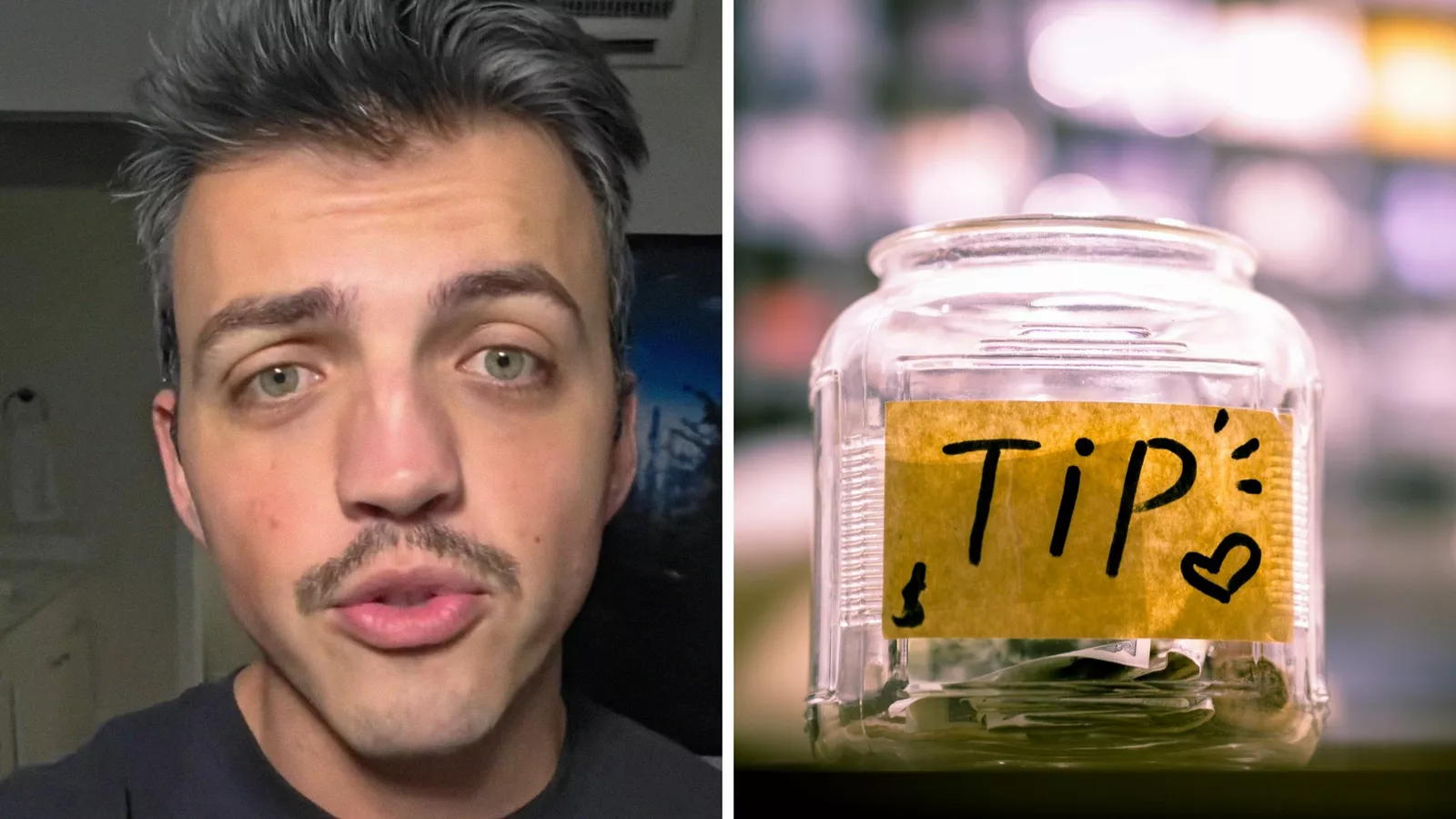
Andrew Tarr (@thetarrpit), an Austin, Texas-based comedian, posted a TikTok describing a scheme to extract bigger tips from Black customers. The concept involves deliberately making them think they’re experiencing racist treatment. The video has 359,000 views. Almost no one in the 450-plus comments is calling it racist. They’re trading stories, debating whether it works, and workshopping the idea.
“Here’s an unethical way to get larger tips from Black people,” he started. “This method requires two servers.”
The breakdown from the clip goes as follows. Tarr says he had already sat and served a table of four white people. Then, he had a Black couple come in for a table. At some point, he passed the table off to a co-worker because he wanted to go home.
The co-worker took over the table. Meanwhile, Tarr continued serving his other (white) table nearby. However, the Black couple ended up leaving before the white women. From a certain perspective, this could have made the switch look even more pointed—like he was willing to serve white customers but not Black ones.
In hindsight, Tarr says it’s probable that the Black couple interpreted his handing them off to another server as racist treatment. When they got their bill, they left an approximately $100 tip. Tarr framed this as them trying to “teach him a lesson” or disprove the stereotype that Black people are bad tippers by overtipping.
He ends by saying, “And then I thought, ‘Well, hey, this “good server, bad server” game I just played doesn’t have to be an accident.’”
He’s a comedian, and he is clearly attempting to make a joke. However, he manages to operate a handful of things here. First, his joke relies on a racist myth that Black people won’t tip well on their own.
Then, knowing that Black customers are vigilant about being treated differently, because they often are, he sees a site for exploitation by staging fake discrimination.
Per an NPR report on tipping, “If a waiter says, ‘I don’t want to wait on that table because they’re black or they’re Hispanic,’ then they tend to give less service, and it’s a self-fulfilling prophecy.”
This has long been a problem. A University of North Carolina survey on “tableside racism” from 2012 revealed “results showed that 38.5 percent of servers reported that customers’ race informed their level of service at least some of the time, often resulting in providing inferior service to African-American customers. Findings show that many servers perceive African-American customers to be impolite and/or poor tippers, suggesting that black patrons, in particular, are likely targets of servers’ self-professed discriminatory actions.”
And there’s more, as it was “also found that 52.8 percent of servers reported seeing other servers discriminate against African-American customers by giving them poor service at least some of the time.”
What Tarr is describing is essentially a proposal to weaponize the concept, all while tipping, itself, has a sordid history.
Tarr appears to be advocating for the extraction of money from Black people via tipping. The practice, however, is, per one title of a 2024 Economic Policy Institute report, “a racist relic and a modern tool of economic oppression in the South.”
The fact that “workers in restaurants, bars, [and] nail salons” are paid per hour less than “virtually all other occupations … is a uniquely American institution that is rooted in the exploitation of formerly enslaved Black workers following emancipation,” wrote author Nina Mast. “Tipping in the U.S. originated in the antebellum period.”
The U.S. established various rules and laws, such as the 1938 Fair Labor Standards Act (FLSA) and its subsequent amendments. However, the tombed history was long buried and absorbed into common practice.
Mast also reported, “Across the U.S., poverty rates for tipped workers are 2.3 times as high as poverty rates for non-tipped workers (11.3% vs. 4.9%). The South [, including Texas and D.C. in this study,] has the highest regional share of tipped workers living in poverty (12.7%), tied with the Midwest.”
The most troubling aspect of this video is the comments section. The casual nature of the racism is unsurprising, given that it is TikTok, and racists typically hide behind anonymous accounts.
For example, one user writes, “When I was a pizza delivery guy, you could tell IMMEDIATELY if you weren’t going to get a tip, just by how melanated the name sounded. You were always correct.”
One man, Lucent, wrote, “It’s called stereotype threat. It’s why they pay more at dealerships, too.” “They,” here, are apparently Black people.
“I was a server when I was young,” said one person. “The servers would literally argue over who was going to take [Black customers]. Nobody wanted to bc they knew they were going to complain about the food for comps, then box everything up and take it all home. The manager gave them the comps just so they wouldn’t have to deal with them.”
The casual racism of the “joke” and the comments creates a normalization of racist behavior. Without specifics, the current political climate has also allowed racists to be more forthright in their intellectual absurdity, even behind fake accounts.
And, as in this case, it often goes unchecked. Tarr’s video and comments aren’t anomalous.
“On social media, especially because people don’t engage in intimate, personal relationships, young generations have become more casual about race and less sensitive to say those things,” historian Larry G. Earl said in an article from The Oracle. “It’s starting to be considered everyday use and will usually just fly over the heads of young people, which in some ways can be very problematic.”
AllHipHop reached out to Tarr via TikTok comment and direct message for more information. We will update the article upon response.
@thetarrpit what are some other unethical restaurant hacks #restaurant ♬ original sound – Andrew tarr



 Loading ...