
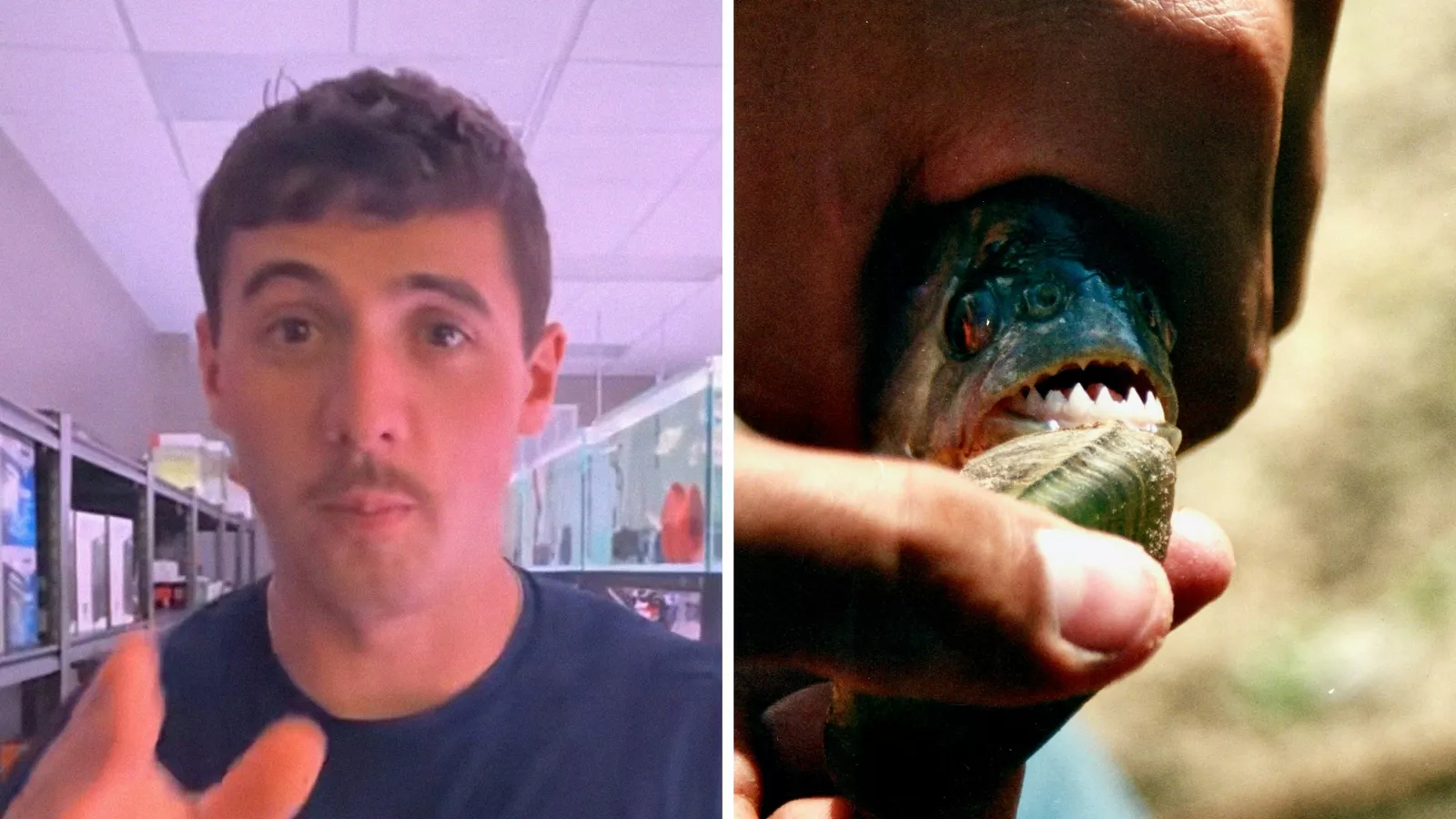
Aquatic life enthusiast RJ Corbitt (@aquabeastsrj) was at Fish World Aquarium in Cincinnati with a special clip for his fans. The aquarium owner was going to feed their prized Black Peru Piranha, a $1,000 fish, and the largest, most fearsome species of piranha. Corbitt’s excitement was palpable and audible.
“You’re about to get a treat,” he said in the brief clip. “They’re going to feed this $1,000 Black Peru Piranha, which is the largest piranha species there is. This thing is terrifying.”
It’s not overly exciting. After all, its food was pieces of cut-up fish. One diabolical commenter said, “Feed it [live fish], goldfish, or better yet, an angelfish. I used to have piranha. Feeding just dead pieces of fish is no fun.”
But don’t underestimate these animals.
With its black body, blood-red eyes, and bite force that pound-for-pound exceeds that of much larger animals, this apex predator can transform mealtime into a spectacle.
Normally just about a foot long and 5–6 lbs, the force of its bite is legendary. In 2011, Steve Huskey, a Ph.D. functional morphologist at Western Kentucky University, recorded the first documented bite force of a Black Peru Piranha. The bite force was 70 psi, despite it weighing nearly 2 lbs, rivaling that of a great white shark.
There is a reason there is only one in the tank. The Black Piranha is the largest and most aggressive of the Piranha species, described by one angler as a “bodybuilder on steroids.” These aren’t like the Piranha you see in Hollywood movies, hunting in packs. They maintain a solitary existence.
These Piranha will eat a wide range of foods, from plants and fallen fruits to animals smaller than themselves, such as insects and small fish.
They are found in northern South America, within the drainage systems of the Amazon and Orinoco Rivers. But they can also be found in the Essequibo River and other rivers of the Guiana Shield, as well as in coastal rivers of northeastern Brazil.
Sure, theoretically, you could buy this exact fish. It is a rare find, given that they don’t do well in captivity at scale. The one advertised, like most redeye piranha, is likely wild-caught in South America.
But per the website, “piranhas cannot be shipped to the states of Alabama, Alaska, California, New York, Arizona, Arkansas, Hawaii, Florida, Colorado, Kentucky, Maine, Georgia, Louisiana, Nevada, New Mexico, Mississippi, Utah, Texas, Washington, North and South Carolina, Oklahoma, Ohio (some cities and counties), Virginia, Idaho, Connecticut and Massachusetts.”
If you don’t live in a state on this list, or you’re close enough to drive to Cincinnati, you’re in the money. You’ll also need a tank that can accommodate at least 150 gallons of water. As long as they are cared for as instructed, they can live over 10 years.
AllHipHop has reached out to Corbitt and Fish World Aquarium via email. This article will be updated upon response.
@aquabeastsrj ♬ original sound – Rj Corbitt



 Loading ...